
FOFO vs FOCO vs FICO: Which Franchise Model Is Best for You?
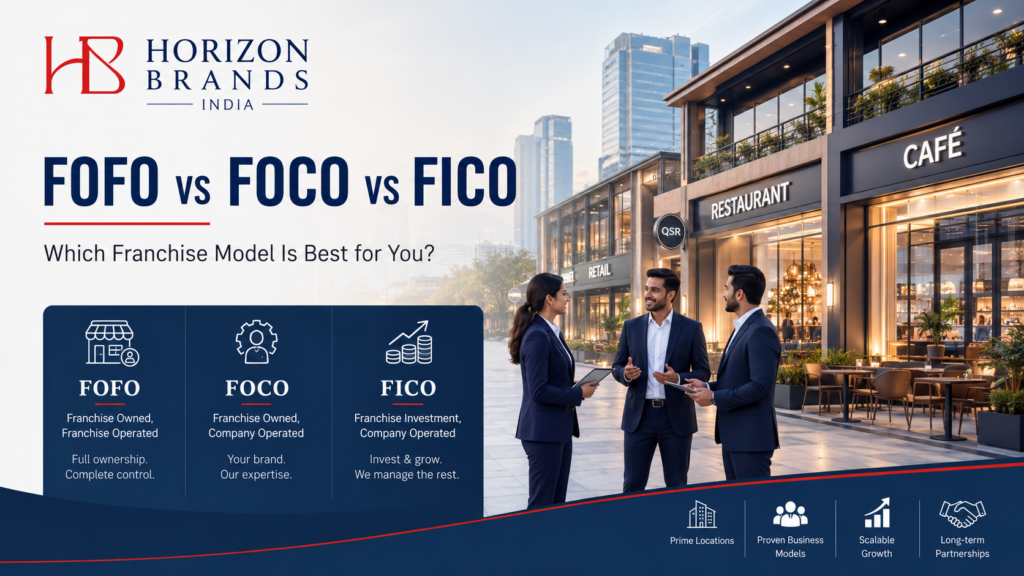
Choosing the right franchise model is one of the most important decisions for any investor, property owner or brand owner. FOFO, FOCO and FICO serve different goals, and the best choice depends on investment capacity, operational involvement and long-term expectations.
In India’s growing franchise market, these models are widely used across restaurants, cafés, QSR brands, cloud kitchens, retail stores, bakeries, salons, fitness centres, education brands and service-based businesses. Each model has its own structure, benefits and responsibilities.
Before investing in any franchise opportunity, it is important to understand how these models work and which one suits your business goals.
What Is the FOFO Model?
FOFO stands for Franchise Owned Franchise Operated.
In this model, the franchisee invests in the outlet and also manages daily operations. The brand provides support in planning, setup, training, product supply, menu or service structure, marketing guidance and operational systems. However, the franchisee is responsible for running the outlet on a day-to-day basis.
This includes staff management, customer service, local marketing, sales, expenses, quality control and overall outlet performance.
FOFO is one of the most common franchise models because it gives the franchisee ownership as well as operational control.
Who Should Choose the FOFO Model?
The FOFO model is suitable for investors and entrepreneurs who want to be actively involved in the business. It is ideal for people who are ready to manage the outlet, hire staff, handle customers and work on daily sales growth.
This model works well for restaurants, cafés, bakeries, QSR brands, retail stores, wellness centres, cloud kitchens and service-based businesses.
If you want to build your own business with the support of an established brand, FOFO can be a good option.
Benefits of the FOFO Model
The biggest benefit of FOFO is control. The franchisee has direct involvement in daily operations and can work actively to improve sales and customer experience.
The franchisee also gets the advantage of working under a recognised brand name, proven business format and established systems. Instead of starting from zero, the investor gets a structured business model.
FOFO can also offer better profit potential because the franchisee manages operations directly and controls expenses. However, success depends heavily on the franchisee’s management skills, local market understanding and operational discipline.
What Is the FOCO Model?
FOCO stands for Franchise Owned Company Operated.
In this model, the franchisee or investor invests in the outlet, but the brand manages the operations. The investor usually provides the capital for setup, interiors, equipment and infrastructure, while the company operates the outlet through its own team and systems.
The brand handles staff, operations, sales, customer service, quality control, marketing execution and daily management. The investor receives returns as per the agreed structure, which may include fixed returns, revenue share, profit share or a combination of different financial terms.
FOCO is preferred by investors who want to invest in a brand-led business but do not want to manage daily operations.
Who Should Choose the FOCO Model?
FOCO is suitable for investors, property owners and business owners who have capital but do not want to be involved in daily operations. It is also suitable for people who want a more passive investment opportunity.
This model is common in food brands, cloud kitchens, QSR chains, cafés, restaurants and retail formats where the brand wants to maintain strong control over customer experience and operational quality.
If you want to invest but do not have experience in running a business, FOCO can be a more suitable option than FOFO.
Benefits of the FOCO Model
The main benefit of FOCO is professional management. Since the brand operates the outlet, the business is handled by people who understand the product, systems, staff training and customer experience.
For investors, this reduces the stress of daily management. They do not have to handle staff issues, vendor coordination, kitchen operations, customer complaints or local marketing.
For brands, FOCO helps maintain better quality and consistency because operations remain under company control.
However, investors should carefully understand the return structure, agreement terms, investment amount, lock-in period, reporting system and exit conditions before entering a FOCO model.
What Is the FICO Model?
FICO stands for Franchise Invested Company Operated.
FICO is similar to FOCO in many ways, but the structure may vary depending on the brand and investment terms. In this model, the franchise partner or investor invests in the outlet, while the company operates the business.
The key idea is that the investor provides investment support, and the brand uses its own operational expertise to run the outlet. The investor may receive returns through minimum guarantee, revenue share, profit share or another agreed financial model.
FICO is often used when the brand wants operational control and the investor wants a structured business opportunity without managing the outlet personally.
Who Should Choose the FICO Model?
FICO is suitable for investors who want to participate in a brand’s growth journey but do not want to handle operations directly. It is also useful for property owners who want to convert their commercial space into an income-generating branded outlet.
This model can work well for QSR brands, food courts, cloud kitchens, restaurants, cafés, bakeries, fitness formats, retail brands and service-based concepts.
If your priority is brand-led operation with investment-based participation, FICO can be a suitable model.
Benefits of the FICO Model
FICO gives the investor access to a professional brand system without requiring operational expertise. The brand manages the outlet, maintains quality standards and works on business performance.
For the brand, this model supports expansion with investor participation. It helps the company grow into new markets without fully blocking its own capital in every location.
For property owners, FICO can also be an attractive model because it can bring a reputed brand to their space and improve the commercial value of the property.
FOFO vs FOCO vs FICO: Key Difference
The main difference between these models is ownership, investment and operational control.
In FOFO, the franchisee invests and operates the outlet.
In FOCO, the franchisee invests, but the company operates the outlet.
In FICO, the investor funds the outlet and the company operates it under a structured investment-led model.
FOFO is more suitable for active entrepreneurs. FOCO and FICO are more suitable for investors who want brand-managed operations.
Which Model Is Best for Investors?
For investors, FOCO and FICO are usually more attractive because they reduce operational involvement. These models allow investors to associate with a brand while the company manages the business.
However, investors must check important points before investing. These include expected returns, minimum guarantee, revenue share, brand experience, location approval, operational reporting, agreement period, investment breakup and risk factors.
FOFO can also be good for investors who want to become business owners and are ready to manage the outlet actively.
Which Model Is Best for Property Owners?
Property owners can benefit from FOCO or FICO models if they want to bring a strong brand to their commercial space. A branded outlet can improve footfall, rental value and overall commercial visibility.
For builders and developers, these models are also useful for pre-leasing commercial projects. When a project has known brands, it becomes easier to attract investor buyers and create market confidence.
If a property owner wants only rental income, a lease model may be suitable. But if they want to participate in a business opportunity, FOCO or FICO can be explored depending on the brand terms.
Which Model Is Best for Brand Owners?
For brand owners, the right model depends on expansion goals.
FOFO allows faster expansion because franchisees invest and operate their own outlets. This model works well when the brand has strong training systems and can monitor quality properly.
FOCO and FICO allow better operational control. These models are useful when the brand wants to maintain consistency in product quality, customer experience, staff training and service standards.
Many brands use a mix of models depending on location, investment, market potential and franchise partner profile.
Things to Check Before Choosing Any Franchise Model
Before selecting FOFO, FOCO or FICO, investors and brands should clearly understand the business structure.
Important points include investment amount, expected returns, setup cost, working capital, brand fee, royalty, revenue share, staff cost, agreement period, lock-in period, location approval, training support, marketing support, reporting system and exit terms.
A franchise model should never be selected only on the basis of expected returns. It should be selected after understanding risk, responsibility, market demand and brand capability.
Final Recommendation
There is no single franchise model that is best for everyone.
FOFO is best for people who want ownership and active involvement.
FOCO is best for investors who want brand-managed operations.
FICO is best for investment-led partnerships where the brand operates and the investor supports expansion through capital.
The right choice depends on your investment capacity, time involvement, business experience, location and return expectations.
How Horizon Brands India Helps
Horizon Brands India helps investors, property owners, builders and brands understand the right franchise and leasing models. Our team works on brand expansion, franchise structuring, commercial leasing, pre-leasing, investor opportunities and location strategy.
We help connect the right brand with the right investor, location and business model.
Whether you are planning to invest in a franchise, lease your commercial property to a brand or expand your own business, Horizon Brands India can help you choose the right model with a structured and practical approach.
Conclusion
FOFO, FOCO and FICO are three important franchise models, and each model has its own benefits. FOFO offers active business ownership, while FOCO and FICO offer more brand-managed structures for investors.
Before making a decision, it is important to understand your goals, investment capacity and level of involvement.
A well-chosen franchise model can create long-term business growth, better returns and a stronger partnership between the brand and the investor.