Why Commercial Space Owners Should Consider Brand Leasing
Owning a commercial property is a valuable asset, but generating consistent returns from that property requires the right leasing strategy. In today’s competitive real estate market, simply having a commercial space is not enough. Property owners, builders, developers, mall owners, food court owners, and high-street commercial space owners need strong tenants who can attract customers, maintain the space professionally, and create long-term rental or revenue potential.
This is where brand leasing becomes an important opportunity.
Brand leasing allows commercial space owners to lease their property to established or growing brands such as restaurants, cafés, QSR brands, retail stores, salons, gyms, fashion outlets, jewellery stores, supermarkets, sweet shops, bakeries, and lifestyle businesses. Instead of renting to an unknown tenant, property owners can work with structured brands that bring better visibility, organised operations, and stronger market confidence.
What Is Brand Leasing?
Brand leasing is the process of connecting commercial properties with suitable national, regional, or international brands. These brands may operate in categories such as food and beverage, fashion, fitness, hospitality, retail, beauty, wellness, jewellery, lifestyle, or service-based businesses.
In simple words, brand leasing means using your commercial space as a business location for a recognised or professionally structured brand.
For example, a commercial property owner may lease space to:
- A QSR or fast-food brand
- A café or bakery brand
- A sweet shop or restaurant
- A gym or fitness studio
- A salon or wellness brand
- A fashion or apparel store
- A jewellery or lifestyle retail brand
- A supermarket or grocery brand
- A hotel, food court, or hospitality concept
The main advantage is that a brand tenant can improve the value, activity, and market appeal of the commercial property.
Why Brand Leasing Is Better Than Random Leasing
Many commercial property owners lease their spaces to tenants without evaluating the long-term potential of the tenant’s business. This can lead to frequent vacancy, delayed payments, poor maintenance, weak footfall, and limited property value growth.
Brand leasing is different because it focuses on matching the right brand with the right property, location, area, frontage, catchment, and business model.
A good brand tenant does not just occupy the space. It helps activate the location.
When a known or well-positioned brand enters a commercial project, it can attract customers, improve the visibility of the property, and build confidence among other investors, tenants, and buyers.
Key Benefits of Brand Leasing for Commercial Space Owners
1. Better Footfall and Customer Movement
One of the biggest benefits of brand leasing is improved footfall. Strong brands naturally attract customers because people recognise them, trust them, or are curious to experience them.
Food brands, cafés, bakeries, sweet shops, supermarkets, gyms, salons, and retail outlets can bring daily or weekly customer movement to a commercial location. This is especially useful for malls, high streets, food courts, commercial complexes, mixed-use projects, and highway properties.
When one good brand enters a project, it can also help attract other brands and tenants.
2. Long-Term Rental Stability
Reputed brands usually prefer stable locations and long-term business planning. This can help commercial property owners reduce the risk of frequent tenant changes.
A strong lease with a structured brand can provide better rental stability, predictable income, and improved long-term planning. For builders and developers, brand leasing can also help position a project as active, reliable, and investment-worthy.
3. Stronger Property Value
A commercial property with reputed brands is usually more attractive than an empty or randomly leased property. Branded tenants can improve the perceived value of the space.
For commercial projects, the right brand mix can increase buyer confidence. Investors often feel more secure when they see known brands operating inside a project. This is why pre-leased commercial spaces and brand-backed leasing models are becoming more popular.
A property with the right brands can become more than just a building. It can become a commercial destination.
4. Better Market Positioning
Every commercial property needs a clear identity. Is it a food destination? A lifestyle retail zone? A premium high-street market? A fitness and wellness hub? A family shopping complex? A highway food stop?
Brand leasing helps define that identity.
When the right category mix is planned, the property becomes more organised and marketable. For example, a commercial project may include:
- A café or bakery for daily footfall
- A restaurant for family dining
- A gym for regular membership-based visits
- A fashion store for lifestyle appeal
- A salon or wellness brand for repeat customers
- A supermarket or grocery outlet for daily needs
This type of planning creates a stronger commercial ecosystem.
5. Better Tenant Quality
A major concern for property owners is tenant reliability. Unknown tenants may lack financial stability, business planning, operational discipline, or long-term commitment.
Brands usually work with defined systems, business models, operational standards, and customer service processes. This can help maintain the professional image of the commercial property.
A professionally managed tenant is more likely to maintain signage, interiors, customer experience, hygiene, operations, and brand standards.
6. Improved Project Appeal for Builders and Developers
For builders and commercial developers, brand leasing can be a powerful sales and marketing tool.
When buyers see that a commercial project has brand tie-ups or leasing potential with reputed businesses, they may feel more confident about investing. A project with strong brands looks more active, more credible, and more future-ready.
Brand leasing can help developers with:
- Pre-leased commercial property planning
- Retail mix strategy
- Food court planning
- Anchor tenant positioning
- High-street activation
- Investor confidence building
- Better commercial project visibility
7. Higher Potential for Revenue Share Models
In some cases, commercial space owners may explore fixed rent, minimum guarantee, revenue share, or hybrid leasing models. These structures depend on the brand, location, business category, and final commercial terms.
For high-potential locations, revenue share models can become attractive because the property owner participates in the business performance of the brand. However, these models should be carefully structured with proper agreements, reporting systems, and financial clarity.
8. Reduced Vacancy Risk
Vacancy is one of the biggest challenges in commercial real estate. An empty space not only stops rental income but also affects the overall look and energy of the property.
Brand leasing can help reduce vacancy risk by positioning the property for suitable business categories. Instead of waiting for any tenant, the owner can target brands that fit the location and customer catchment.
For example:
- A highway property may be suitable for restaurants, QSRs, cafés, or food plazas.
- A residential catchment may be suitable for supermarkets, bakeries, salons, gyms, or daily need brands.
- A premium high-street property may be suitable for fashion, jewellery, cafés, wellness, or lifestyle brands.
- A mall or food court may be suitable for QSRs, desserts, beverages, and fast-casual dining.
Types of Brands Commercial Space Owners Can Lease To
Commercial property owners can explore brand leasing opportunities across many categories, including:
- Food and beverage brands
- QSR and fast-food brands
- Cafés and bakeries
- Sweet shops and snack brands
- Restaurants and casual dining brands
- Clothing and fashion brands
- Jewellery brands
- Gym and fitness brands
- Salon and beauty brands
- Wellness and lifestyle brands
- Hotel and hospitality brands
- Retail and supermarket brands
- Entertainment and kids activity brands
The right category depends on the location, space size, frontage, parking, nearby audience, rental expectation, and long-term commercial potential.
What Commercial Space Owners Should Check Before Leasing to a Brand
Before leasing your commercial space to any brand, you should evaluate a few important factors:
- Is the location suitable for the brand category?
- Does the space have proper visibility and access?
- Is parking available?
- What is the required area and frontage?
- What is the expected rental or revenue model?
- Is the brand financially and operationally capable?
- What is the lease tenure and lock-in period?
- Who will handle interiors and setup?
- What signage rights are required?
- Are approvals, licenses, and compliance responsibilities clear?
- Is the agreement professionally structured?
A well-planned leasing decision can protect both the property owner and the brand.
Why Location-Brand Fit Matters
Not every brand is suitable for every location. The success of brand leasing depends on matching the right brand with the right commercial space.
For example, a premium café may need a high-street or lifestyle location, while a QSR may work well in a food court, market, college area, or highway property. A gym may need a larger area and accessible parking, while a jewellery store may require premium positioning and strong customer trust.
This is why brand leasing should not be random. It should be strategic.
How Horizon Brands India Helps Commercial Space Owners
Horizon Brands India works as a strategic bridge between commercial space owners, builders, developers, investors, and brands.
We help commercial property owners explore suitable brand leasing opportunities by understanding the property location, area, category fit, investment potential, and business model. Our focus is to connect the right brand with the right commercial space.
Horizon Brands India supports:
- Commercial space leasing to brands
- Brand-led leasing strategy
- Builder and developer partnerships
- Retail mix planning
- Food court and high-street activation
- Pre-leased commercial property positioning
- Franchise and brand expansion connections
- FOFO, FOCO, and FICO model opportunities
Whether you own a high-street shop, food court space, mall unit, highway property, commercial complex, or mixed-use project, brand leasing can help unlock stronger business potential.
Conclusion
Commercial space owners should consider brand leasing because it can create stronger visibility, better footfall, long-term rental potential, improved property value, and better market positioning.
In today’s market, the right tenant is not just someone who pays rent. The right tenant is someone who activates the space, attracts customers, builds credibility, and strengthens the commercial ecosystem.
Brand leasing gives property owners and builders a more strategic way to use commercial real estate.
If you are a commercial space owner, builder, or developer looking to lease your property to suitable brands, Horizon Brands India can help you explore the right opportunities.
The Future of Food & Beverage Franchising in India
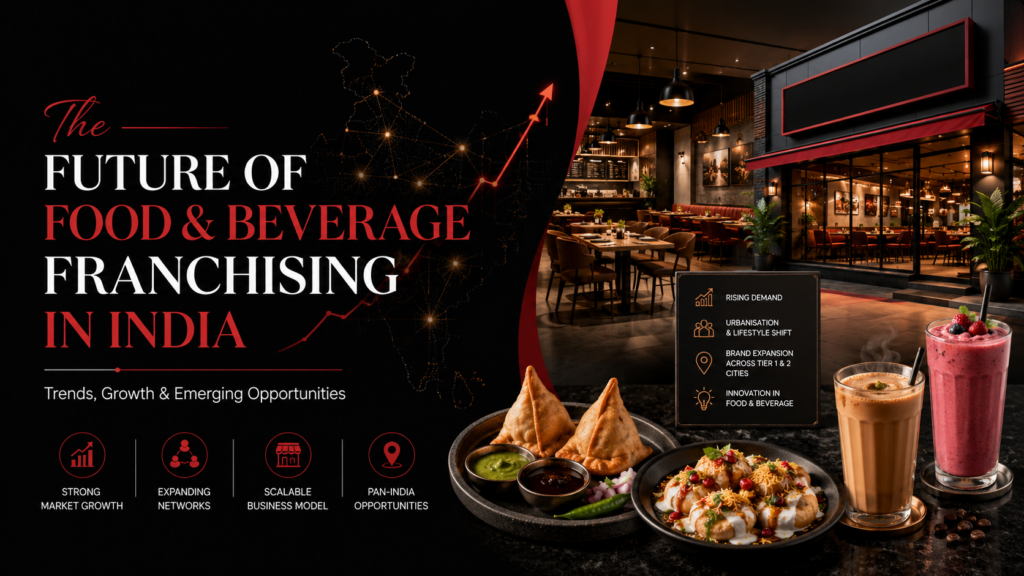
India’s food and beverage industry is entering a strong growth phase, driven by changing consumer habits, urbanisation, organised retail expansion, delivery platforms, and rising demand for branded food experiences. From QSR outlets and cafes to sweet shops, bakery concepts, cloud kitchens, food courts, and casual dining restaurants, the F&B franchise model is becoming one of the most attractive business opportunities for investors, entrepreneurs, commercial property owners, and growing food brands.
Food is not just a daily need in India; it is an emotional, cultural, and social experience. This makes the food and beverage sector one of the most promising categories for franchise expansion. Investors are increasingly looking for structured food franchise opportunities that offer brand support, operational systems, training, menu guidance, and scalable business formats.
Why Food & Beverage Franchising Is Growing in India
The future of food and beverage franchising in India is being shaped by a few major shifts. Consumers are now more open to branded food outlets, hygienic dining environments, quick-service formats, cafe culture, and delivery-friendly food concepts. At the same time, commercial spaces, malls, highways, high streets, and food courts are actively looking for strong food brands that can increase footfall and customer engagement.
For investors, food franchising offers a practical entry into the business world because many franchise models come with predefined SOPs, branding, vendor guidance, training support, and operational structures. This reduces the risk of starting everything from scratch.
QSR Brands Will Continue to Lead Expansion
Quick Service Restaurant brands are expected to remain one of the strongest formats in the food franchise segment. QSR brands work well because they are compact, scalable, fast-moving, and suitable for food courts, malls, high streets, highways, universities, markets, and delivery-focused locations.
Categories such as momos, burgers, chaat, South Indian food, Chinese cuisine, rolls, pizza, desserts, bakery snacks, beverages, and Indian street food have strong demand across Tier 1, Tier 2, and Tier 3 cities. This creates major opportunities for both new and established QSR franchise brands in India.
For investors, QSR franchise opportunities can be attractive because they often require relatively lower space compared to large restaurants and can operate with standardised menus and faster service models.
Cafe and Bakery Brands Are Becoming Lifestyle Businesses
Cafe and bakery franchises are no longer limited to coffee and cakes. They are becoming lifestyle spaces where people work, meet, relax, celebrate, and socialise. This has created demand for premium cafe franchise opportunities, bakery outlets, dessert bars, coffee concepts, and hybrid food retail formats.
A well-positioned cafe or bakery brand can work in high-street markets, commercial complexes, office zones, premium residential areas, universities, malls, and mixed-use developments. With the right product mix, ambience, pricing, and brand positioning, cafe and bakery businesses can become highly scalable.
Indian Food Concepts Have Strong Franchise Potential
Indian food has a natural advantage in the franchise market because it connects deeply with local taste preferences. Chaat, tikki, sweets, snacks, thali concepts, South Indian food, tandoori formats, bakery sweets, and regional cuisines can be developed into powerful franchise brands.
The future will favour Indian food brands that can combine authentic taste with modern presentation, hygiene, standardised operations, attractive store design, and delivery compatibility. This is where structured franchise planning becomes important.
Cloud Kitchens and Delivery-Friendly Models Will Keep Expanding
Cloud kitchens have changed the way food brands operate. For many entrepreneurs, cloud kitchens offer a lower-entry business model compared to traditional restaurants. They allow brands to test menus, operate multiple virtual brands, and serve customers through online ordering platforms.
However, the future of cloud kitchens will not depend only on delivery apps. Successful cloud kitchen brands will need strong branding, consistent food quality, efficient packaging, repeat customers, and profitable unit economics. Investors should choose cloud kitchen opportunities that are backed by a clear operating model and strong brand strategy.
FOFO, FOCO and FICO Models in Food Franchising
Food and beverage franchising in India is also evolving through multiple business models. The most common models include FOFO, FOCO and FICO.
FOFO Model
FOFO stands for Franchise Owned, Franchise Operated. In this model, the franchisee invests in and operates the outlet while following the brand’s systems, menu guidelines, SOPs, training processes, and marketing standards.
This model is suitable for entrepreneurs who want active involvement in the business.
FOCO Model
FOCO stands for Franchise Owned, Company Operated. In this model, the investor owns the outlet, but daily operations are managed by the brand or operating company.
This model is suitable for investors who want business ownership with reduced daily involvement.
FICO Model
FICO is useful for commercial property owners, builders, and investors who want to connect commercial spaces with suitable food brands. In food franchising, this model can help activate food courts, highways, malls, mixed-use projects, and high-street commercial properties.
This model is suitable for property owners looking for brand-backed leasing and long-term ROI opportunities.
Tier 2 and Tier 3 Cities Will Drive the Next Phase
One of the biggest future trends in F&B franchising is expansion beyond metro cities. Consumers in Tier 2 and Tier 3 cities are actively seeking branded food experiences, better ambience, hygienic outlets, and modern dining options.
Cities across Punjab, Haryana, Himachal Pradesh, Chandigarh, Rajasthan, Uttar Pradesh, Uttarakhand, Madhya Pradesh, Gujarat and other regions offer strong potential for food franchise brands. Lower rental costs, growing disposable income, and increasing demand for branded outlets make these markets highly attractive.
Commercial Spaces Need Strong Food Brands
Food brands play a major role in the success of commercial projects. A strong restaurant, cafe, QSR or sweet shop can increase footfall, attract families, improve buyer confidence, and make a commercial location more active.
Builders, developers, mall owners, and commercial property owners are now focusing on brand mix planning. Instead of leasing spaces randomly, they are looking for categories that bring daily customers and long-term value. Food and beverage brands are one of the most important parts of this strategy.
What Investors Should Check Before Choosing an F&B Franchise
Before investing in a food franchise, investors should carefully evaluate:
- Brand positioning and market demand
- Investment range and setup cost
- Space requirement
- Expected operating cost
- Menu strength and product quality
- Training and operational support
- Location suitability
- Delivery potential
- ROI expectations
- Franchise agreement terms
- Marketing and brand support
A food franchise should not be selected only because the brand looks popular. The right decision depends on the business model, target market, location, support system, and long-term scalability.
What Makes a Food Brand Franchise-Ready?
Not every food business is ready for franchising. A food brand becomes franchise-ready when it has a clear menu, defined SOPs, consistent product quality, vendor systems, training process, store design format, pricing structure, and marketing identity.
Brands that want to expand across India should first create a professional franchise model. This includes investment planning, space model, franchise fee, royalty structure, setup support, training system, operational manual, and expansion strategy.
The Role of Horizon Brands India
Horizon Brands India works as a strategic platform connecting food brands, investors, property owners, builders, and entrepreneurs through structured franchise and brand leasing models.
We support franchise opportunities, brand expansion, commercial space activation, food and hospitality consulting, FOFO models, FOCO models, and FICO leasing opportunities. Our focus is to bring the right brand, the right investor, and the right location together.
Whether you are an investor looking for a food franchise, a brand planning to expand, or a property owner looking to lease commercial space to a food brand, Horizon Brands India can help you explore suitable opportunities.
Conclusion
The future of food and beverage franchising in India is strong, scalable, and full of opportunity. With rising demand for branded food experiences, QSR growth, cafe culture, cloud kitchens, commercial leasing, and expansion into Tier 2 and Tier 3 cities, the F&B franchise sector will continue to attract serious investors and growing brands.
The key to success is choosing the right business model, right location, right brand, and right operating structure. With professional planning and strategic support, food and beverage franchising can become one of the most powerful business growth opportunities in India.
If you are looking to explore food franchise opportunities, list your F&B brand, or lease your commercial space to a suitable food brand, Horizon Brands India can help you take the next step.
How National Brands Increase the Value of Commercial Projects

Commercial real estate is no longer only about location, construction quality and available space. Today, the real value of a commercial project is strongly influenced by the kind of brands it attracts. A project with the right mix of national brands can create higher visibility, better footfall, stronger investor confidence and long-term commercial value.
For builders, developers and commercial property owners, national brand leasing has become one of the most effective ways to position a project as a premium business destination.
Why Brand Presence Matters in Commercial Projects
When people see a known restaurant, café, retail chain, QSR brand, gym, fashion store or lifestyle brand in a commercial project, it immediately creates trust. A national brand carries its own market reputation, customer base and operational credibility. This helps the commercial project stand out from ordinary buildings or vacant retail spaces.
A strong brand does not only occupy space. It activates the project.
It brings customers, improves visibility, supports other businesses and creates a stronger commercial environment. This is why branded leasing plays an important role in increasing the value of commercial real estate.
1. National Brands Build Market Confidence
A commercial project with recognised national brands creates confidence among buyers, investors and tenants. Investors feel more secure when they see that reputed brands are already associated with the project.
This confidence is especially important during the launch or pre-leasing stage. When a builder can show confirmed or proposed brand interest, the project becomes easier to sell. Investor buyers are more likely to consider such properties because the project already has a clear commercial direction.
In simple terms, national brands make the project look more reliable, more active and more investment-worthy.
2. They Increase Footfall and Customer Movement
One of the biggest advantages of national brands is their ability to attract customers. A popular food brand, café, retail store, supermarket, salon, gym or QSR outlet can bring regular visitors to the project.
More footfall benefits the entire commercial ecosystem. Other tenants also get better visibility, walk-in customers and business opportunities. This makes the project more attractive for future leasing as well.
A commercial project with regular customer movement naturally becomes more valuable than a space that depends only on location.
3. They Improve Rental Potential
National and established brands usually prefer long-term business locations. Their presence helps the property command better rental value compared to unbranded or randomly leased spaces.
For property owners and builders, this can improve rental returns and long-term income stability. A project that has reputed brands as tenants often receives better attention from investors because rental income becomes more predictable.
This is one of the main reasons why pre-leased commercial properties with national brands are considered stronger investment options.
4. They Strengthen Project Positioning
Every commercial project needs a clear identity. Is it a food destination? A fashion and lifestyle hub? A high-street retail project? A family shopping destination? A business and service centre?
National brands help define this positioning.
For example, a project with QSR brands, cafés and restaurants can be positioned as a food and leisure destination. A project with fashion, jewellery and lifestyle brands can be positioned as a premium retail hub. A project with gyms, wellness centres and cafés can attract a completely different audience.
When the brand mix is planned properly, the commercial project gets a stronger market identity.
5. They Help Builders Sell Faster
In commercial real estate, buyers usually look for security, returns and future appreciation. If a project has brand leasing potential or confirmed brand interest, the sales team can present it as a stronger investment opportunity.
This helps builders create better sales conversations. Instead of selling only square feet, they can sell a complete business opportunity.
A branded commercial project gives investors a reason to believe that the property can generate income, attract customers and grow in value over time.
6. They Reduce Vacancy Risk
Vacant commercial spaces reduce the value and reputation of a project. Long-term vacancy also creates doubt in the market.
National brands reduce this risk by occupying spaces with clear business plans, professional operations and long-term expansion strategies. Their presence also attracts other businesses, making the overall leasing process easier.
When one strong brand enters a project, it often improves the chances of bringing more quality tenants.
7. They Create a Better Customer Experience
Successful commercial projects are not built only with shops and offices. They are built with experience.
Customers prefer destinations where they can shop, eat, relax, explore and spend time. National brands contribute to this experience through professional interiors, quality service, standardised operations and better customer engagement.
A well-planned brand mix can turn a commercial building into an active destination.
8. They Increase Long-Term Asset Value
The value of a commercial project grows when it becomes active, trusted and income-generating. National brands support all three.
They improve the project’s visibility, create business activity, attract customers, improve rental potential and build confidence among investors. Over time, this strengthens the overall asset value of the project.
For builders and property owners, this means better market reputation and stronger long-term returns.
9. Brand-Led Leasing Creates a Stronger Investment Story
Today’s investors are not only buying property. They are buying a return opportunity.
When a commercial project has a clear leasing strategy, national brand association and projected rental potential, it becomes easier for investors to understand the value of the project.
A project with branded leasing can be presented with a stronger ROI story, better tenant profile and long-term income potential. This makes it more attractive in a competitive real estate market.
The Role of Strategic Brand Leasing
Bringing national brands into a commercial project requires proper planning. It is not only about finding tenants. It requires understanding the project location, catchment area, target audience, space size, frontage, visibility, parking, rentals, brand category and business model.
A wrong brand mix can affect the project’s performance. A well-planned brand mix can increase its commercial value.
This is where strategic brand leasing becomes important.
Horizon Brands India works with builders, developers, investors, property owners and brands to create structured commercial leasing opportunities. The focus is to connect the right brand with the right location and the right business model so that both the brand and the project can grow successfully.
Conclusion
National brands play a powerful role in increasing the value of commercial projects. They bring trust, footfall, visibility, rental potential and long-term commercial strength. For builders and developers, brand-led leasing can improve project positioning, support faster sales and create stronger investor confidence.
In today’s competitive commercial real estate market, the right brand can turn a project into a destination.
With strategic planning, proper brand selection and structured leasing, commercial projects can achieve better market value, stronger returns and long-term success.
Horizon Brands India helps builders, developers, investors and property owners activate commercial spaces through strong brand partnerships, franchise models and structured leasing strategies.
How to Choose the Right Franchise Brand for Your Investment
Choosing the right franchise brand is one of the most important decisions for any investor, entrepreneur, or business owner. A franchise can give you access to an established brand name, proven business model, training support, operational systems, marketing guidance, and structured growth potential. However, not every franchise opportunity is suitable for every investor.
The right franchise brand should match your investment capacity, location, business goals, operational involvement, market demand, and long-term vision. Before investing, it is important to evaluate the opportunity carefully instead of choosing a brand only because it looks popular.
In India, franchise opportunities are growing across food and beverage, QSR brands, cafes, bakeries, sweet shops, restaurants, fashion, retail, gyms, salons, hotels, lifestyle brands, and service-based businesses. With so many options available, investors need a clear method to select the right franchise brand.
Why Choosing the Right Franchise Brand Matters
A franchise investment is not just about buying a brand name. It is about entering a business system. The success of a franchise depends on the brand’s strength, support system, location fit, operating model, customer demand, and financial planning.
A good franchise brand can help you start faster, avoid common mistakes, and operate with defined systems. A wrong franchise selection, however, can lead to high costs, weak sales, operational difficulties, location mismatch, or slow returns.
This is why franchise brand selection should be done strategically.
1. Understand Your Investment Budget
The first step in choosing the right franchise brand is understanding your investment capacity. Every franchise opportunity has a different investment requirement depending on the category, brand value, space size, interiors, equipment, franchise fee, working capital, inventory, and location.
For example, a small QSR or kiosk franchise may require a lower investment, while a restaurant, sweet shop, gym, fashion store, or premium retail outlet may require a higher setup cost.
Before finalising any brand, calculate:
- Franchise fee
- Setup and interior cost
- Equipment cost
- Initial stock or inventory
- Rent and security deposit
- Staff cost
- Marketing cost
- Working capital
- Licenses and approvals
- Monthly operating expenses
A good franchise decision should fit your budget comfortably. Avoid investing your entire capital only in setup. Keep enough working capital for initial months.
2. Match the Brand With Your Location
Location is one of the biggest success factors in a franchise business. Even a strong brand may not perform well if the location is not suitable for its target audience.
Before choosing a franchise brand, study your location carefully. Check the surrounding audience, footfall, parking, visibility, nearby businesses, competition, rental cost, road access, and customer profile.
For example:
- A QSR brand may work well in food courts, markets, highways, colleges, malls, and busy streets.
- A cafe or bakery may perform better in premium residential areas, office zones, commercial markets, or lifestyle locations.
- A gym or fitness brand needs easy access, parking, and a strong residential catchment.
- A fashion or jewellery brand needs premium visibility and a suitable customer profile.
- A sweet shop or bakery may work well in family-focused markets and high-footfall residential zones.
The right brand should match the right location.
3. Evaluate Market Demand
Before investing in any franchise, understand whether there is real demand for that product or service in your target market.
Ask yourself:
- Do people in this area need this product or service?
- Is the category growing?
- Are customers already buying similar products?
- Is there too much competition?
- Can the brand create repeat customers?
- Is the pricing suitable for the local market?
For food and beverage franchises, demand may depend on taste, price, hygiene, delivery potential, and local preferences. For fashion, jewellery, gyms, salons, and retail brands, demand may depend on income level, lifestyle, customer trust, and brand positioning.
A franchise should not be chosen only because it is trending. It should have sustainable demand.
4. Understand the Franchise Model
Different brands operate under different franchise models. The three common models are FOFO, FOCO, and FICO.
FOFO Model
FOFO stands for Franchise Owned, Franchise Operated. In this model, the investor owns and operates the business while following the brand’s systems, SOPs, training, marketing guidelines, and operational processes.
This model is suitable for entrepreneurs who want active involvement in the business.
FOCO Model
FOCO stands for Franchise Owned, Company Operated. In this model, the investor owns the business, but the brand or operating company manages day-to-day operations.
This model is suitable for investors who want business ownership with reduced daily involvement.
FICO Model
FICO is useful for investors, builders, and commercial property owners who want brand-led commercial leasing or investment-backed business opportunities. It is especially relevant for people who own commercial spaces and want to connect with suitable brands.
Before investing, understand which model suits your involvement level and income expectations.
5. Check Brand Support and Training
A franchise brand should provide proper support. The level of support can make a major difference in business performance.
Check whether the brand provides:
- Site selection guidance
- Store layout and design support
- Setup assistance
- Staff training
- SOPs and operational manuals
- Vendor support
- Menu or product guidance
- Marketing support
- Launch support
- Technology or billing support
- Quality control
- Ongoing business guidance
A franchise with strong support is usually easier to operate than a brand that only gives you the name and leaves you to manage everything independently.
6. Study the Brand’s Business Model
Before choosing a franchise brand, study the business model in detail. A good franchise should have a clear revenue structure and operational plan.
Understand:
- How does the business earn money?
- What are the major costs?
- What is the expected gross margin?
- What are the monthly expenses?
- What is the expected break-even period?
- What is the royalty structure?
- What are the marketing contributions?
- What is the expected ROI?
- What is the minimum sales required to sustain the outlet?
Do not rely only on verbal promises. Ask for practical numbers and understand the assumptions behind them.
7. Check Space Requirement
Every franchise brand has a specific space requirement. Some concepts work in small formats, while others need larger commercial spaces.
For example:
- Kiosk brands may require 100–300 sq. ft.
- QSR outlets may require 250–800 sq. ft.
- Cafes and bakeries may require 500–1,500 sq. ft.
- Restaurants may require 1,500–4,000 sq. ft.
- Gyms may require 2,000–6,000 sq. ft.
- Sweet shops and premium food retail may require 1,500–4,500 sq. ft.
- Fashion and retail stores may require space depending on brand format.
Before choosing a franchise, ensure your available space matches the brand’s operating format.
8. Review Franchise Agreement Terms
The franchise agreement is a very important document. It defines your rights, responsibilities, payments, territory, brand usage, renewal terms, exit clauses, and operational obligations.
Before signing, review:
- Franchise fee
- Royalty
- Agreement duration
- Lock-in period
- Renewal terms
- Territory rights
- Marketing fee
- Product sourcing rules
- Brand guidelines
- Termination clauses
- Exit conditions
- Training and support commitments
It is always better to take legal or professional advice before signing a franchise agreement.
9. Compare Multiple Franchise Options
Do not finalise the first brand you see. Compare multiple franchise opportunities within the same category and investment range.
Compare brands on:
- Brand positioning
- Investment requirement
- Space requirement
- Support system
- ROI potential
- Market demand
- Royalty and fees
- Operational complexity
- Location suitability
- Expansion potential
A careful comparison helps you make a more confident investment decision.
10. Check Your Own Involvement Level
Every investor has a different goal. Some want to run the business personally. Some want a side business. Some want passive investment. Some own commercial property and want long-term rental or revenue potential.
Your involvement level should decide the model you choose.
If you want active control, FOFO may be suitable.
If you want reduced daily involvement, FOCO may be better.
If you own commercial space and want brand-led leasing, FICO may be more relevant.
Choosing a model that does not match your lifestyle can create stress later.
11. Evaluate Brand Reputation and Expansion Readiness
A good franchise brand should have a professional identity, customer appeal, operational clarity, and expansion readiness.
Check whether the brand has:
- Clear brand positioning
- Defined product or service range
- Standard operating processes
- Training system
- Marketing identity
- Quality control
- Existing outlets or pilot model
- Customer reviews or market acceptance
- Professional franchise documentation
A brand that is not ready for franchising may struggle to support its franchise partners.
12. Understand Local Competition
Competition is not always bad. It can prove that demand exists. But too much competition without differentiation can affect sales.
Study:
- Similar brands nearby
- Their pricing
- Customer response
- Product quality
- Footfall
- Strengths and weaknesses
- Gaps in the market
Choose a franchise that offers something better, different, or more professionally positioned.
13. Look at Long-Term Scalability
A good franchise investment should not only work today but also have potential for future growth. Some investors start with one outlet and later expand into multiple locations.
Choose a brand that has:
- Repeat customer potential
- Expansion-ready systems
- Scalable format
- Strong category demand
- Adaptability for different locations
- Marketing and operational support
- Long-term relevance
The best franchise brands are not just profitable at one location; they are capable of growing across markets.
14. Avoid Common Franchise Selection Mistakes
Many investors make mistakes while choosing a franchise. Avoid these common errors:
- Choosing only because the brand looks popular
- Ignoring location suitability
- Underestimating working capital
- Not understanding royalty and fees
- Not reading the agreement properly
- Believing unrealistic ROI promises
- Not checking market demand
- Choosing a business without personal interest
- Ignoring operational complexity
- Not comparing other options
A franchise investment should be based on research, planning, and professional guidance.
How Horizon Brands India Helps Investors
Horizon Brands India helps investors, entrepreneurs, property owners, and builders explore suitable franchise and brand leasing opportunities.
We help you understand different franchise models, evaluate business categories, explore investment opportunities, connect with brands, and identify suitable commercial formats. Our focus is to bring the right brand, right investor, and right location together.
Horizon Brands India supports:
- Franchise opportunity selection
- FOFO, FOCO, and FICO model understanding
- Brand comparison
- Commercial space matching
- Food and hospitality consulting
- Brand expansion support
- Investor enquiry assistance
- Category-wise franchise guidance
Whether you are looking for a food franchise, QSR brand, cafe franchise, sweet shop, restaurant, fashion retail, gym, salon, or commercial leasing opportunity, Horizon Brands India can help you explore structured options.
Conclusion
Choosing the right franchise brand for your investment requires careful planning. A good franchise should match your budget, location, involvement level, business goals, and market demand.
Before investing, evaluate the brand’s support system, business model, ROI potential, agreement terms, space requirement, and long-term scalability. The right franchise brand can help you enter business with structure, confidence, and growth potential.
If you are planning to invest in a franchise business or want to explore suitable brand opportunities, Horizon Brands India can help you take the next step.
FOFO vs FOCO vs FICO: Which Franchise Model Is Best for You?
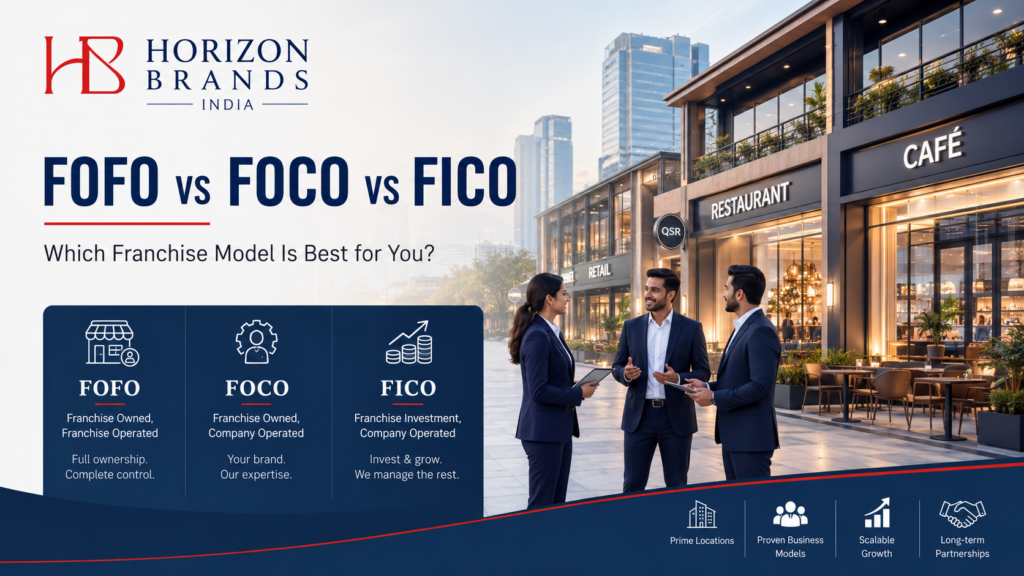
Choosing the right franchise model is one of the most important decisions for any investor, property owner or brand owner. FOFO, FOCO and FICO serve different goals, and the best choice depends on investment capacity, operational involvement and long-term expectations.
In India’s growing franchise market, these models are widely used across restaurants, cafés, QSR brands, cloud kitchens, retail stores, bakeries, salons, fitness centres, education brands and service-based businesses. Each model has its own structure, benefits and responsibilities.
Before investing in any franchise opportunity, it is important to understand how these models work and which one suits your business goals.
What Is the FOFO Model?
FOFO stands for Franchise Owned Franchise Operated.
In this model, the franchisee invests in the outlet and also manages daily operations. The brand provides support in planning, setup, training, product supply, menu or service structure, marketing guidance and operational systems. However, the franchisee is responsible for running the outlet on a day-to-day basis.
This includes staff management, customer service, local marketing, sales, expenses, quality control and overall outlet performance.
FOFO is one of the most common franchise models because it gives the franchisee ownership as well as operational control.
Who Should Choose the FOFO Model?
The FOFO model is suitable for investors and entrepreneurs who want to be actively involved in the business. It is ideal for people who are ready to manage the outlet, hire staff, handle customers and work on daily sales growth.
This model works well for restaurants, cafés, bakeries, QSR brands, retail stores, wellness centres, cloud kitchens and service-based businesses.
If you want to build your own business with the support of an established brand, FOFO can be a good option.
Benefits of the FOFO Model
The biggest benefit of FOFO is control. The franchisee has direct involvement in daily operations and can work actively to improve sales and customer experience.
The franchisee also gets the advantage of working under a recognised brand name, proven business format and established systems. Instead of starting from zero, the investor gets a structured business model.
FOFO can also offer better profit potential because the franchisee manages operations directly and controls expenses. However, success depends heavily on the franchisee’s management skills, local market understanding and operational discipline.
What Is the FOCO Model?
FOCO stands for Franchise Owned Company Operated.
In this model, the franchisee or investor invests in the outlet, but the brand manages the operations. The investor usually provides the capital for setup, interiors, equipment and infrastructure, while the company operates the outlet through its own team and systems.
The brand handles staff, operations, sales, customer service, quality control, marketing execution and daily management. The investor receives returns as per the agreed structure, which may include fixed returns, revenue share, profit share or a combination of different financial terms.
FOCO is preferred by investors who want to invest in a brand-led business but do not want to manage daily operations.
Who Should Choose the FOCO Model?
FOCO is suitable for investors, property owners and business owners who have capital but do not want to be involved in daily operations. It is also suitable for people who want a more passive investment opportunity.
This model is common in food brands, cloud kitchens, QSR chains, cafés, restaurants and retail formats where the brand wants to maintain strong control over customer experience and operational quality.
If you want to invest but do not have experience in running a business, FOCO can be a more suitable option than FOFO.
Benefits of the FOCO Model
The main benefit of FOCO is professional management. Since the brand operates the outlet, the business is handled by people who understand the product, systems, staff training and customer experience.
For investors, this reduces the stress of daily management. They do not have to handle staff issues, vendor coordination, kitchen operations, customer complaints or local marketing.
For brands, FOCO helps maintain better quality and consistency because operations remain under company control.
However, investors should carefully understand the return structure, agreement terms, investment amount, lock-in period, reporting system and exit conditions before entering a FOCO model.
What Is the FICO Model?
FICO stands for Franchise Invested Company Operated.
FICO is similar to FOCO in many ways, but the structure may vary depending on the brand and investment terms. In this model, the franchise partner or investor invests in the outlet, while the company operates the business.
The key idea is that the investor provides investment support, and the brand uses its own operational expertise to run the outlet. The investor may receive returns through minimum guarantee, revenue share, profit share or another agreed financial model.
FICO is often used when the brand wants operational control and the investor wants a structured business opportunity without managing the outlet personally.
Who Should Choose the FICO Model?
FICO is suitable for investors who want to participate in a brand’s growth journey but do not want to handle operations directly. It is also useful for property owners who want to convert their commercial space into an income-generating branded outlet.
This model can work well for QSR brands, food courts, cloud kitchens, restaurants, cafés, bakeries, fitness formats, retail brands and service-based concepts.
If your priority is brand-led operation with investment-based participation, FICO can be a suitable model.
Benefits of the FICO Model
FICO gives the investor access to a professional brand system without requiring operational expertise. The brand manages the outlet, maintains quality standards and works on business performance.
For the brand, this model supports expansion with investor participation. It helps the company grow into new markets without fully blocking its own capital in every location.
For property owners, FICO can also be an attractive model because it can bring a reputed brand to their space and improve the commercial value of the property.
FOFO vs FOCO vs FICO: Key Difference
The main difference between these models is ownership, investment and operational control.
In FOFO, the franchisee invests and operates the outlet.
In FOCO, the franchisee invests, but the company operates the outlet.
In FICO, the investor funds the outlet and the company operates it under a structured investment-led model.
FOFO is more suitable for active entrepreneurs. FOCO and FICO are more suitable for investors who want brand-managed operations.
Which Model Is Best for Investors?
For investors, FOCO and FICO are usually more attractive because they reduce operational involvement. These models allow investors to associate with a brand while the company manages the business.
However, investors must check important points before investing. These include expected returns, minimum guarantee, revenue share, brand experience, location approval, operational reporting, agreement period, investment breakup and risk factors.
FOFO can also be good for investors who want to become business owners and are ready to manage the outlet actively.
Which Model Is Best for Property Owners?
Property owners can benefit from FOCO or FICO models if they want to bring a strong brand to their commercial space. A branded outlet can improve footfall, rental value and overall commercial visibility.
For builders and developers, these models are also useful for pre-leasing commercial projects. When a project has known brands, it becomes easier to attract investor buyers and create market confidence.
If a property owner wants only rental income, a lease model may be suitable. But if they want to participate in a business opportunity, FOCO or FICO can be explored depending on the brand terms.
Which Model Is Best for Brand Owners?
For brand owners, the right model depends on expansion goals.
FOFO allows faster expansion because franchisees invest and operate their own outlets. This model works well when the brand has strong training systems and can monitor quality properly.
FOCO and FICO allow better operational control. These models are useful when the brand wants to maintain consistency in product quality, customer experience, staff training and service standards.
Many brands use a mix of models depending on location, investment, market potential and franchise partner profile.
Things to Check Before Choosing Any Franchise Model
Before selecting FOFO, FOCO or FICO, investors and brands should clearly understand the business structure.
Important points include investment amount, expected returns, setup cost, working capital, brand fee, royalty, revenue share, staff cost, agreement period, lock-in period, location approval, training support, marketing support, reporting system and exit terms.
A franchise model should never be selected only on the basis of expected returns. It should be selected after understanding risk, responsibility, market demand and brand capability.
Final Recommendation
There is no single franchise model that is best for everyone.
FOFO is best for people who want ownership and active involvement.
FOCO is best for investors who want brand-managed operations.
FICO is best for investment-led partnerships where the brand operates and the investor supports expansion through capital.
The right choice depends on your investment capacity, time involvement, business experience, location and return expectations.
How Horizon Brands India Helps
Horizon Brands India helps investors, property owners, builders and brands understand the right franchise and leasing models. Our team works on brand expansion, franchise structuring, commercial leasing, pre-leasing, investor opportunities and location strategy.
We help connect the right brand with the right investor, location and business model.
Whether you are planning to invest in a franchise, lease your commercial property to a brand or expand your own business, Horizon Brands India can help you choose the right model with a structured and practical approach.
Conclusion
FOFO, FOCO and FICO are three important franchise models, and each model has its own benefits. FOFO offers active business ownership, while FOCO and FICO offer more brand-managed structures for investors.
Before making a decision, it is important to understand your goals, investment capacity and level of involvement.
A well-chosen franchise model can create long-term business growth, better returns and a stronger partnership between the brand and the investor.